Emanuele Biggi / naturepl
Emanuele Biggi / naturepl
Introduced pathogen
Introduced pathogen; First documented outbreaks of Bd in the 1990s in Australia and Central America. Thought to have been present in environment since early 1900s.
Batrachochytrium dendrobatidis (Bd); Batrachochytrium salamandrivorans (Bsal)
Fungi
Chytridiomycota
Chytridiomycota
Rhizophydiales
The causative agents of chytridmycosis, Bd and Bsal are species of microscopic fungi that has resulted in the spread the disease and mass mortality across six continents and even the extinction of some species. Bd is a known to infect amphibians worldwide and Bsal is currently thought to be restricted to Europe and Asia where it infects newts and salamanders.
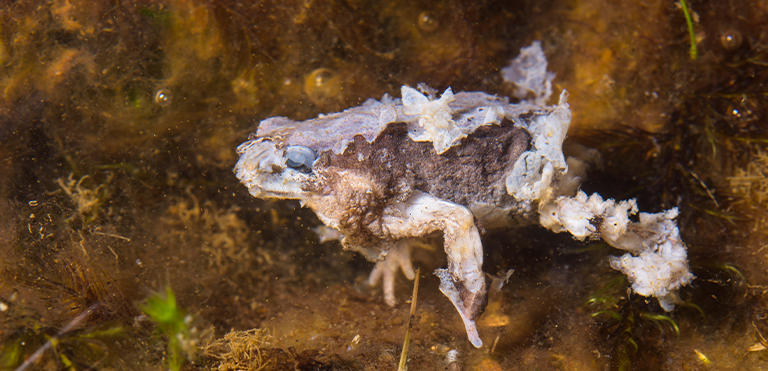
It is thought that chytrid fungus causes mortality by blocking sodium uptake channels on the skin surface; the lack of sodium results in poor circulating and the heart ceases to beat. Typical symptoms include skin reddening, excessive skin shedding , seizures or atypical behaviours (e.g., daytime activity in nocturnal species) and abnormal posture.
The infectious stage known as the zoospore is motile in water and latches onto host amphibians where it develops before shedding more zoospores into the environment.
Although it is shown that many amphibian species in the UK and Ireland have been infected, not all species are susceptible, with some showing some tolerance (e.g., Natterjack toad). Treatment is not possible in the wild.
Surveys can be conducted all-year-round however, based on the hibernation of amphibians, we would suggest surveying from April-October when individuals are more active.