Native; listed as Least Concern on the IUCN global Red List of Threatened Species.
Widespread throughout the country, but absent from some Scottish islands, the Isles of Scilly and most of the Channel Islands. The loss of hedgerows and a decline in rabbit populations are factors that could have a negative impact on the species. Legally protected in Ireland but not in the United Kingdom.
Mustela erminea
2 - 5 years
24 - 32cm
9 - 14cm
140 - 450g
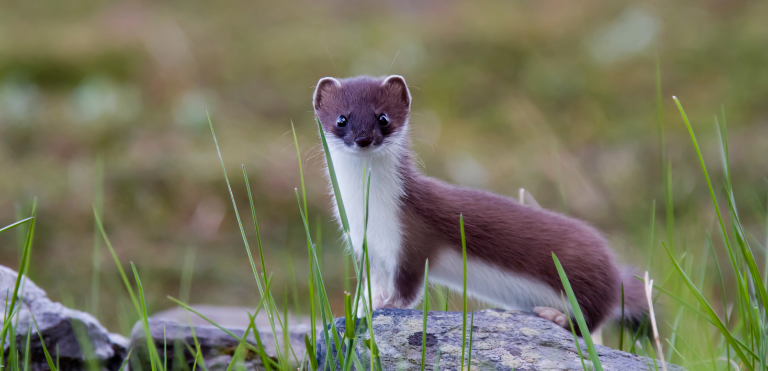
A small mustlid related to the weasel and otter. It has a creamy/white throat and belly, an orangey-brown back, and a black-tipped tail. Similar to a weasel, however a stoat is larger, with a longer tail and a distinctive bounding gait. The stoat’s long, low-slung body makes it well suited to hunting small rodents and rabbits. Though much larger than itself, it can easily kill an adult rabbit. Stoats are easiest to spot in open habitats such as grassland, sand dunes, and heathland. They mate in summer, but delay implantation of the fertilised egg until the spring of the following year. In winter, stoats living in colder climates may turn completely white, with just a black tip on their tail (known as ‘ermine’). Stoats living in warmer parts of the UK may not change colour at all. This species avoids spending long periods of time in the open as it is more vulnerable to attack from foxes and birds of prey; it will instead stick to cover and use features such as hedgerows and walls to move around.
Specimens can be analysed all year round. Stoats are active by day and night.