Dietmar Nill / naturepl
Dietmar Nill / naturepl
Native and Least Concern
Native and listed as Least Concern on the global IUCN Red List of Threatened Species. Data deficient in the UK. Protected in the UK under the Wildlife and Countryside Act, 1981. European Protected Species under Annex IV of the European Habitats Directive.
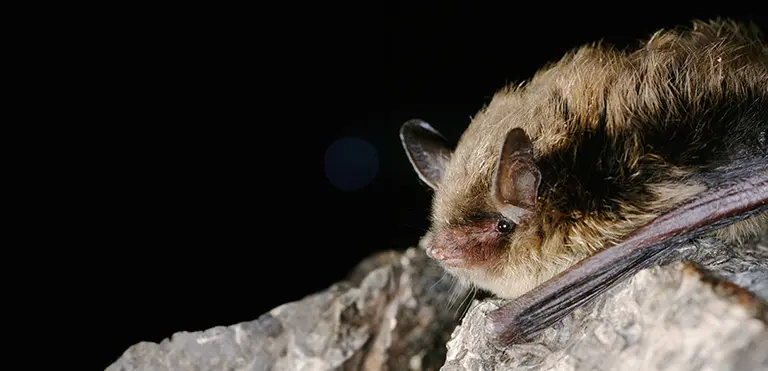
Myotis brandtii
Up to 40 years
3.8 - 5cm; Wingspan: 21 - 24cm
21 - 24cm
4.5 - 9.5g
Thought to be less common than the whiskered bat (Myotis mystacinus), Brandt’s bats are found throughout much of England and Wales and have recently been recorded in Ireland.
Brandt’s bats closely resemble whiskered bats and were only identified as a separate species in 1970. They are typically slightly larger than whiskered bats and occasionally share roof spaces with them, as well as with pipistrelles and brown long-eared bats.
Favouring crevices, Brandt’s bats can be found roosting in buildings under hanging tiles, within cavity walls, and beneath ridge tiles. They are also known to roost in trees and bat boxes.
Threats to the species include the loss of woodland habitats for roosting and feeding as well as the ecological impacts of modern farming practices.
Can survey all-year-round. Most active from April to October. Droppings found within roosts can be analysed outside of active periods.